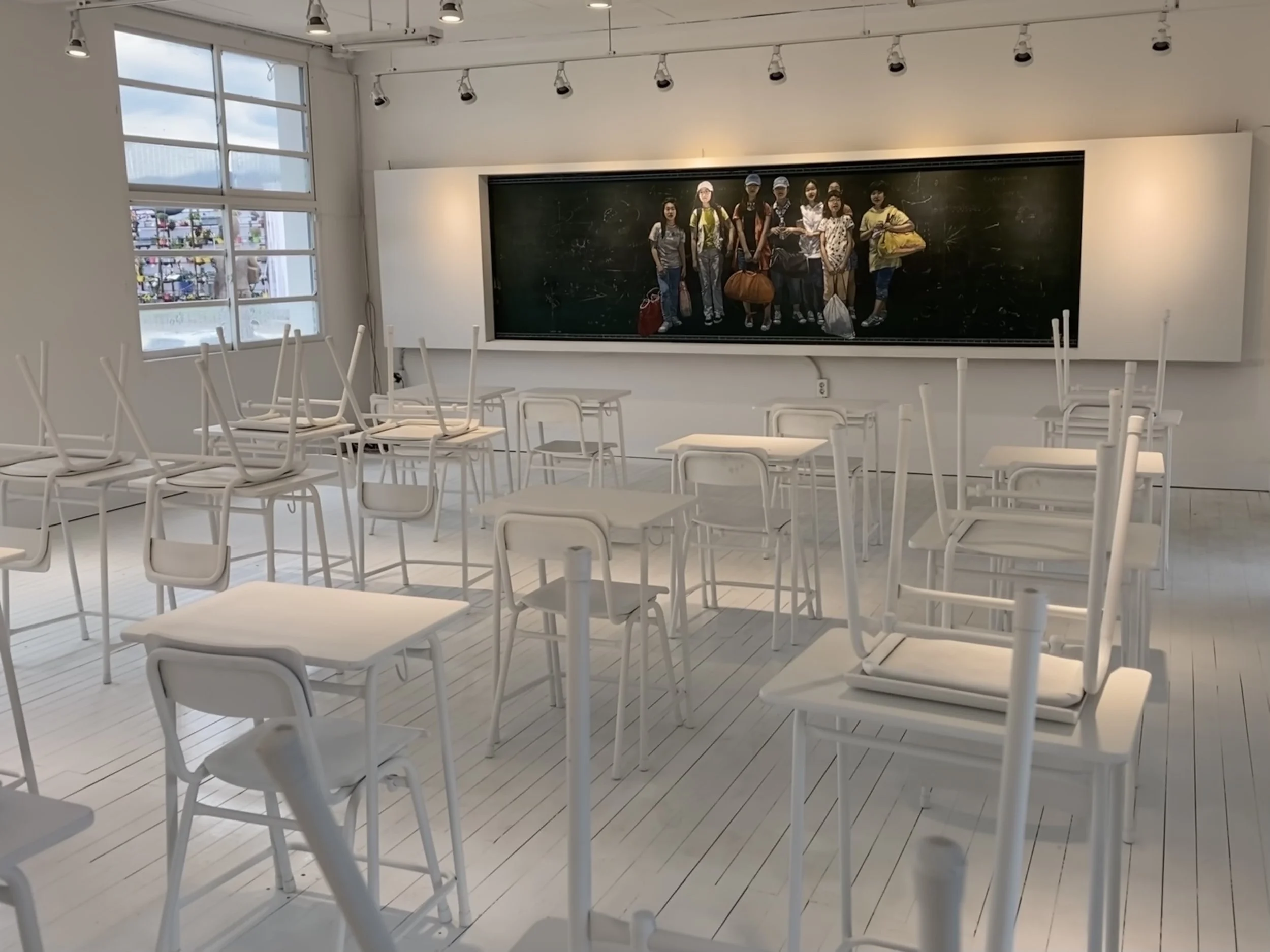
Since the early 1990s, Myong Hi Kim 김명희 has pursued a singular artistic path rooted in lived experience, place, and historical reflection. After an early period marked by an exploration of time and space across Eastern and Western civilizations, she chose to settle in a closed elementary school in Gangwon Province, where she continues to live and work as part of a small, self-sustaining community. This remote setting has become both her dwelling and her studio—a site where daily life and artistic practice are inseparably intertwined.
Kim’s long years abroad and her eventual return to rural Korea have shaped her enduring inquiry into settlement and nomadism, dwelling and migration. Moving between Korea, the United States, and meta traveling through Central Asia, she has developed a body of work that probes the historical conditions and contemporary realities of human movement. Her paintings engage with the layered narratives of migration, displacement, and belonging, questioning how civilizations remember, forget, and transform.
Widely recognized for her use of chalkboards as a primary surface, Kim reclaims these discarded objects as horizons of perception. More than mere supports, the chalkboards function as conceptual and material thresholds—windows through which she reflects on the accumulated time of her chosen place of residence and on lives shaped by forced migration across Central Asia. Through them, everyday remnants become vessels of memory, history, and ethical contemplation.
Kim’s practice is distinguished by a profound sincerity that binds her way of living to her way of making art. Grounded in contemporary reality yet extended along a historical axis, her work situates the present within an anthropological frame. By continually widening her perceptual and sensory boundaries—both within and beyond her place of dwelling—she constructs a life that is itself an evolving artistic form. In doing so, Myong Hi Kim 김명희 offers a rare model of art as an embodied, ethical, and deeply human practice.